
Romance: A Love Story and Its Music
September 20, 1891
On September 20, 2020, I published a blogpost entitled, “Another Place at Another Time: Ivanovka on September 20, 1891”. In it, I asked you to indulge my romantic fantasy that involved a bit of time travel. Now, six years later, I ask you once again to return to Ivanovka through this piece of historical fact and fiction.
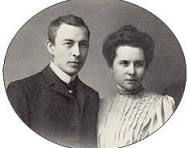
FACT: the great Russian composer/pianist, Sergei Rachmaninoff (1873-1943) completed Two Pieces (Valse, Romance) 135 years ago today at the family home of his aristocratic relatives, the Satins. The family estate was called Ivanovka. While visiting the estate, he fell in love with his first cousin, Natalia Satin, whom he married in 1902.
The small village of Ivanovka adjoined our estate. Endless fields stretched around us, merging on the horizon with the sky. In the distance, in the west, the belfry of our parish church, located five miles from Ivanovka, was visible. In the north is someone's windmill, to the east is nothing but fields, and to the south is our aspen forest. For many miles around Ivanovka, these aspen trees and our garden near the house were the only trees among the fields, and therefore these aspen trees were a refuge for hares, foxes, and even wolves sometimes running from somewhere, especially for birds that nested their nests there and filling the air with twittering and singing.
—Memoirs of S.A. Satin

On the evening of September 20, 2020 before dinner at Merry Mount, Lee Thompson, Robert Bode, and I played the Romance for six hands on our grand piano. The description of Ivanovka above, particularly the “endless-fields stretched around us, merging on the horizon,” set the scene for us to harken back 129 years to rural Russia. Let’s allow the passages below and a performance of Rachmaninoff's music to take us all back there again.

FICTION: For inspiration, I have borrowed (heavily quoted in Italics below) passages from A Gentleman from Moscow, by Amor Towles. *
Having traveled from [Moscow] by a series of consecutively smaller trains, [Sergei] would finally arrive at that little halt in the high grass on the branch line, where [he] would be met by a [Satin] coach-and-four. With the bags on top, the driver in the carriage… would charge across a countryside waving at every peasant girl until they turned into the road lined with apple trees that led to the family seat.
As [he] shed [his] coat in the entry hall, [Sergei’s] bags would be whisked to the grand bedroom of the east wing, where velvet cords could be pulled to summon a cold beer, or hot water for a bath. But first, [he] would proceed to the drawing room where … the Countess would be hosting some blue-blooded neighbor for tea.
Having paid [his] respects to the Countess, [Sergei] would head out the terrace doors in search of [Natalia]. Sometimes [he] would find her under the pergola overlooking the gardens and sometimes under the elm tree at the bend of the river; but wherever [he] found her, at the sound of [his] approach she would look up from her book and offer a welcoming smile—not unlike the one captured in [her] portrait on the wall.
With [Natalia], [Sergei] was always his most outlandish, claiming as he collapsed on the grass that [he] had just met Tolstoy on the train; or that he had just decided after consideration to join a monastery and take an eternal vow of silence. Immediately. Without a moment’s delay, “Do you really think that silence would suit you?” [Natalia] would ask. “Like deafness suited Beethoven.” Then [Natalia] would laugh, look at her [cousin] and ask, “What is to become of you, [Sergei]?” “That is the question,” [Sergei] would agree. And then he would lie back in the grass and gaze thoughtfully at the figure eights of the fireflies as if he too were pondering this essential enigma.
Soon it was time for dinner and the two returned to the manor house to prepare for the occasion. At the great table, Sergei was seated across from Natalia who was radiant, particularly with a white orchid blossom pinned at her temple joined by a string of pearls that was threaded delicately through her ebony hair. Throughout the meal of turtle soup, stuffed pike-perch, meatballs in sour cream, goose with apples or roast hazel grouse, the two cousins participated in the mannered conversation that circled the table. Their eyes constantly met and revealed the secret desires that flowed between them. After the serving of a dessert torte made from a confection of sponge cake, jam, jelly and champagne, Countess Satin invited everyone to join her in the drawing room and Sergei was asked to play one of his most recent compositions. Sergei approached the Grand, nodded to his Aunt, then turned his gaze to Natalia, and with a quick wink began to pour his passion for her into the ivory keys of the great piano.
After the Countess called for the final piece of music of the evening (a Nocturne by Chopin), she rose and dismissed the family gathering. Natalia gracefully crossed the room and whispered in Sergei’s ear. She stood erect, smiled coyly, and departed.
At the appointed time, Sergei arrived at Natalia’s room. He found her door ajar. Looking left and looking right, he slipped inside and closed the door. On the side of the table before an ornate mirror [he noticed the string of pearls and the white orchid blossom from her hair.] After taking a quick look around, [Sergei] crossed the empty sitting room and entered the bedchamber, where a willowy figure stood in silhouette before one of the great windows. At the sound of his approach, she turned and let her dress slip to the floor with a delicate whoosh….

Rachmaninoff composing in the garden at Ivanovka
In conclusion, I offer the following performance of Rachmaninoff’s sublime Romance. Listen and allow it to take you back to 19th Century Russia and perhaps the date of September 20 will be engraved on your soul.
* Towles (pgs. 129-131; 295-296)
CPW


Comments